


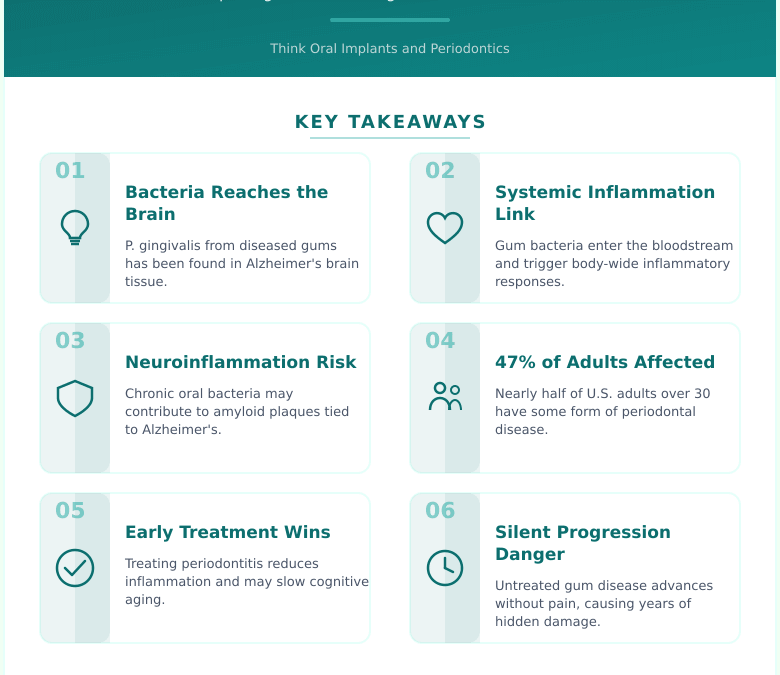
Gum disease and Alzheimer’s risk are now linked by a growing body of research suggesting that chronic periodontitis creates systemic inflammation that may accelerate cognitive decline. Understanding this connection could change how you think about routine gum care.
This guide focuses specifically on what the Alzheimer’s-periodontitis research means for everyday patients and how gum health connects to long-term cognitive well-being.
Here is the thing most people miss: your mouth is not separate from the rest of your body. The bacteria that thrive in diseased gums don’t just stay local. They enter the bloodstream, trigger inflammatory responses, and – based on what researchers are finding – may reach the brain. According to data published through the National Institute of Dental and Craniofacial Research, roughly 47 percent of adults over 30 in the United States have some form of periodontal disease. That’s a significant portion of the population carrying a potentially underappreciated risk factor.
What the Gum Disease and Alzheimer’s Risk Research Actually Shows
The connection between gum disease and Alzheimer’s risk has moved from speculative to scientifically compelling. Researchers have identified a specific bacterium called Porphyromonas gingivalis – a key driver of periodontitis – in the brain tissue of Alzheimer’s patients. This doesn’t prove causation, but it raises serious questions that researchers are actively investigating in 2026.
Periodontal disease: A chronic bacterial infection of the gum tissue and supporting structures of the teeth, characterized by persistent inflammation and tissue breakdown.
Neuroinflammation: A state of immune activation in the brain that has been linked to the development and progression of Alzheimer’s disease.
The theory is that oral bacteria and their toxic byproducts (called gingipains) travel through the bloodstream or along nerve pathways, eventually contributing to the amyloid plaques associated with Alzheimer’s. Recent data shows that patients with untreated periodontitis for more than a decade face a measurably elevated risk for cognitive impairment compared to those with healthy gums. That finding alone should get your attention.
Thinking about what this means for your own health? Contact usto schedule a periodontal evaluation and talk through your risk factors – no pressure, just straight answers.
Treating Gum Disease vs. Ignoring It: A Clear Comparison
Where treating gum disease succeeds: Reduces active bacterial load in the mouth, lowers systemic inflammation markers, improves cardiovascular health indicators, and according to emerging research, may slow cognitive aging.
Where treating gum disease falls short: It cannot reverse existing cognitive damage, and treatment requires consistent follow-through over time – it is not a one-time fix.
Where ignoring gum disease seems acceptable: Early-stage gum disease (gingivitis) often causes no pain, making it easy to delay care without obvious short-term consequences.
Where ignoring it fails completely: Untreated periodontitis progresses silently. By the time bone loss is visible on X-rays, years of systemic inflammatory exposure have already occurred. The mouth-brain connection means the stakes go beyond tooth loss.
The verdict: The research strongly favors early, consistent treatment. The cost of managing periodontitis is far lower – financially and health-wise – than the downstream effects of both advanced tooth loss and potential cognitive risk.
Cost ranges reflect general industry averages and are not specific to any individual provider’s fees.
Signs Your Gums May Already Be Affecting Your Systemic Health
The most common mistake patients make is waiting for pain before seeking care. Gum disease rarely hurts until it is advanced. Watch for these warning signs:
According to the American Dental Association, many adults don’t realize they have periodontitis because early stages produce minimal symptoms. By the time discomfort appears, the infection has often been present for years.
- Gums that bleed during brushing or flossing
- Persistent bad breath that doesn’t resolve with brushing
- Gum tissue that appears red, swollen, or pulls away from the teeth
- Teeth that feel loose or have shifted position
- A chronic bad taste in your mouth
Your Gum Health Action Plan
At Think Oral Implants and Periodontics in Paoli, PA, we work with patients from across Chester County – including Malvern, Wayne, Berwyn, Devon, and Exton – who want to understand the full picture of what gum health means for their overall wellness.
- Step 1 – Get a full periodontal evaluation: Ask your provider to measure periodontal pocket depths and take current X-rays to assess bone levels. This gives you a real baseline.
- Step 2 – Address active infection first: If periodontitis is diagnosed, complete scaling and root planing or appropriate treatment before focusing on cosmetic or restorative work.
- Step 3 – Start a consistent home care routine: Brush twice daily, floss or use an interdental brush daily, and consider an antimicrobial rinse if recommended by your provider.
- Step 4 – Schedule periodontal maintenance every 3-4 months: After initial treatment, maintenance visits are not optional – they prevent relapse and keep bacterial levels controlled.
- Step 5 – Track changes over time: Keep records of your pocket depth measurements. Stability over time is a sign your systemic inflammatory burden is being managed.
Before Your Periodontal Appointment: What to Prepare
- ☐ List of current medications (some affect gum tissue)
- ☐ Most recent dental X-rays if switching providers
- ☐ Family history of Alzheimer’s or cognitive decline
- ☐ History of cardiovascular disease or diabetes (both share links with periodontitis)
- ☐ Notes on any symptoms – bleeding, sensitivity, loose teeth
Key Takeaways for Paoli-Area Patients in 2026
- The research is real – the periodontitis-cognitive decline link is based on peer-reviewed findings, not speculation.
- Early treatment matters most – catching and treating gum disease before bone loss occurs offers the best systemic outcomes.
- Inflammation is the common thread – both gum disease and Alzheimer’s involve chronic inflammation, making oral care a genuine brain health strategy.
- Maintenance is not optional – treating gum disease once is not enough. Ongoing care every 3-4 months is what sustains results.
- Your next dental visit could matter more than you think – especially if you have a family history of memory loss.
Frequently Asked Questions
Does gum disease actually cause Alzheimer’s disease?
Current research shows a strong association between periodontitis and Alzheimer’s risk, but direct causation has not been definitively proven. Studies have found oral bacteria linked to gum disease in the brain tissue of Alzheimer’s patients, suggesting a plausible biological pathway involving systemic inflammation.
How does gum bacteria reach the brain?
Oral bacteria can enter the bloodstream through inflamed gum tissue and travel to other organs, including the brain. Some researchers believe bacteria may also travel along the trigeminal nerve, which connects the jaw to the brain directly.
Can treating gum disease reduce Alzheimer’s risk?
Treating periodontitis lowers systemic inflammation, which is a known factor in cognitive decline. While no clinical trial has yet confirmed that gum treatment prevents Alzheimer’s, reducing inflammatory load is broadly considered beneficial for brain health.
How often should someone with gum disease see a periodontist?
Most patients with treated periodontitis benefit from professional maintenance visits every three to four months. Annual or twice-yearly visits are typically not enough to keep periodontal bacteria at controlled levels once disease has been established.
Is gum disease covered by dental insurance?
Most dental insurance plans cover scaling and root planing at 50-80 percent after deductibles, though coverage varies significantly by plan. Periodontal maintenance visits are often covered similarly to standard cleanings. Always confirm specifics with your insurance provider.
What other health conditions are linked to gum disease?
Periodontal disease has well-documented associations with cardiovascular disease, Type 2 diabetes, respiratory illness, and adverse pregnancy outcomes. The shared mechanism is systemic inflammation triggered by chronic oral bacterial infection.
At what age should I start worrying about gum health and brain health together?
Periodontal disease can begin in early adulthood, and Alzheimer’s-related brain changes may start decades before symptoms appear, so oral health habits matter at any age. Most research focuses on adults over 40, but building good periodontal habits early is clearly the smarter path.
What This Means for You Right Now
You don’t need to wait for a diagnosis – of anything – to act on this. If you can’t remember the last time someone measured your gum pocket depths, that’s your starting point. The link between gum disease and Alzheimer’s risk is one of the more compelling reasons to stop treating dental visits as optional.
Ready to get a clear picture of your gum health? Contact usat Think Oral Implants and Periodontics in Paoli, PA to schedule your evaluation. Our team serves patients throughout Chester County and the surrounding Main Line communities. You can also explore our services to learn more about what a periodontal assessment involves.
Note: This content is for educational purposes only and is not a substitute for professional medical or dental advice. Always consult a qualified dental provider regarding your specific health situation.
About the Author
The Think Oral Implants and Periodontics Team , serving patients in Paoli, PA and throughout Chester County. For more information about our approach, visit our homepageor explore our services.