


VISTA gum grafting is a minimally invasive surgical technique that corrects gum recession by repositioning donor gum tissue through a pea-sized access point rather than cutting a donor site from the palate. It preserves natural tissue, reduces recovery time significantly, and delivers predictable root coverage for patients who have lost gum height and thickness due to brushing habits, genetics, or periodontal disease.
This guide focuses specifically on how VISTA gum grafting differs from traditional approaches, who qualifies, and what the full process looks like from first appointment through healing.
VISTA Gum Grafting Definition: VISTA (Vestibular Incision Subperiosteal Tunnel Access) is a minimally invasive periodontal procedure that uses a small tunnel beneath the gum tissue to reposition recession and stabilize it with a donor connective tissue or collagen allograft, avoiding large incisions and palatal harvest wounds.
Gum recession is more common than most people realize. According to the National Institute of Dental and Craniofacial Research, periodontal disease – a leading driver of recession – affects nearly half of adults over 30 in the United States. Left untreated, exposed roots become sensitive, structurally vulnerable, and at higher risk for decay. VISTA gum grafting addresses that problem without the painful recovery that held many patients back from traditional surgery.
Why Traditional Gum Grafts Have a Reputation Problem
The conventional connective tissue graft has been the gold standard for decades. It works. But it requires cutting a strip of tissue from the roof of your mouth, suturing that harvest site closed, then grafting the tissue onto the recession site. You end up healing in two places at once.
Patients undergoing traditional grafts must manage discomfort at both the palate and the graft site throughout recovery. Recovery stretches to two or three weeks, soft-food restrictions apply, and the aesthetic results, while functional, can look slightly patchy if multiple teeth are involved. That’s the gap VISTA was designed to close.
How VISTA Gum Grafting Actually Works
The VISTA technique uses a single small incision – roughly the size of a pea – made in the soft tissue near the gumline. Through that access point, the periodontist creates a tunnel beneath the gum detaching it from the underlying bone. The recessed tissue is gently advanced coronally (toward the crown of the tooth) and a thin connective tissue allograft or acellular dermal matrix is tucked underneath to support the repositioned gum.
Because no large flap is lifted and no palate harvest is required when using a donor matrix, trauma to surrounding tissues stays minimal. Patients typically experience a faster return to normal eating and daily routines compared to traditional graft approaches.
The most common mistake we see is patients waiting until recession has progressed to multiple teeth before seeking treatment. Early intervention makes VISTA considerably more straightforward and the outcomes more predictable.
At Think Oral Implants and Periodontics in Paoli, PA, patients from throughout the Main Line area and surrounding Chester County communities ask about this technique specifically because they’ve read about the faster recovery compared to traditional surgery.
VISTA vs. Traditional Connective Tissue Graft: Which Approach Works?
Where VISTA succeeds: Minimal postoperative discomfort, no palate harvest wound when donor matrix is used, excellent aesthetic blending across multiple recession sites, faster return to normal activity.
Where VISTA has limitations: Requires a periodontist with advanced surgical skill and focused training, may not be appropriate for severe bone loss cases, and outcomes depend heavily on provider technique.
Where traditional connective tissue graft succeeds: Long clinical track record, autogenous tissue integrates predictably, widely available from general periodontists.
Where traditional graft falls short: Two wound sites mean double the healing, aesthetic results can appear less uniform on multiple adjacent teeth, and palate discomfort discourages some patients from proceeding at all.
The verdict: For patients with mild to moderate recession across multiple teeth who prioritize comfort and cosmetic blending, VISTA is the stronger choice. For isolated single-tooth recession where the surgeon’s familiarity with traditional technique is greater, the conventional approach remains an option.
FeatureVISTA Gum GraftingTraditional CTGFree Gingival GraftIncision SizePinhole accessLarge flap + palatePalate harvest onlyRecovery TimeGenerally shorter recoveryLonger recovery typicalModerate recovery periodPalate WoundNone (with matrix)YesYesTypical Cost RangeVaries by provider and areaVaries by provider and areaVaries by provider and areaBest ForMultiple adjacent teeth, comfort-focused patientsSingle tooth, high-volume autogenous tissue neededThickening gum tissue around implants
Cost ranges vary based on the number of teeth treated, materials used, provider, and local market. Dental insurance occasionally covers gum grafting when medically necessary – contact your insurer directly to verify benefits.
Thinking about whether VISTA makes sense for your specific recession? Contact us and we’ll walk you through your options with no pressure.
Your VISTA Gum Grafting Action Plan
Step 1 – Periodontal Evaluation: A periodontist measures recession depth at each tooth using a probe. Expect X-rays and possibly a CBCT scan to assess bone levels and root anatomy.
Step 2 – Treatment Planning: Your provider maps which teeth qualify for VISTA versus alternative approaches based on recession severity, tissue thickness, and bite factors.
Step 3 – Surgical Appointment: VISTA is typically performed under local anesthesia in one session, even when multiple teeth are treated. The procedure takes one to two hours depending on scope.
Step 4 – Immediate Recovery: Most patients manage discomfort with over-the-counter pain relief. Soft foods for the first 48-72 hours. No vigorous brushing at the graft site.
Step 5 – Follow-Up Visits: Sutures (if placed) are removed within one to two weeks. Full tissue integration and final aesthetic results are assessed at the six-week and three-month marks.
- Step 1 – Periodontal Evaluation: A periodontist measures recession depth at each tooth using a probe. Expect X-rays and possibly a CBCT scan to assess bone levels and root anatomy.
- Step 2 – Treatment Planning: Your provider maps which teeth qualify for VISTA versus alternative approaches based on recession severity, tissue thickness, and bite factors.
- Step 3 – Surgical Appointment: VISTA is typically performed under local anesthesia in one session, even when multiple teeth are treated. The procedure takes one to two hours depending on scope.
- Step 4 – Immediate Recovery: Most patients manage discomfort with over-the-counter pain relief. Soft foods for the first 48-72 hours. No vigorous brushing at the graft site.
- Step 5 – Follow-Up Visits: Sutures (if placed) are removed within one to two weeks. Full tissue integration and final aesthetic results are assessed at the six-week and three-month marks.
Pre-Appointment Preparation Checklist
☐ Confirm current medications with your provider – blood thinners and certain supplements may need to pause before surgery
☐ Arrange transportation if sedation is used
☐ Stock soft foods at home (yogurt, eggs, smoothies, mashed potatoes)
☐ Fill any prescriptions before the day of surgery
☐ Ask your insurance carrier specifically about periodontal graft coverage under your plan
- ☐ Confirm current medications with your provider – blood thinners and certain supplements may need to pause before surgery
- ☐ Arrange transportation if sedation is used
- ☐ Stock soft foods at home (yogurt, eggs, smoothies, mashed potatoes)
- ☐ Fill any prescriptions before the day of surgery
- ☐ Ask your insurance carrier specifically about periodontal graft coverage under your plan
Who Is a Good Candidate for VISTA?
Ideal candidate criteria: Patients with Miller Class I or II recession (the root is exposed but surrounding bone is intact), adequate tissue thickness to allow tunnel creation, and no active periodontal infection at the treatment site.
Recent data shows that root coverage outcomes with tunnel-based techniques like VISTA reach 90% or greater in properly selected cases, based on published periodontal literature over the past several years. That’s a meaningful benchmark for anyone weighing the investment.
Patients from Paoli, Wayne, Berwyn, Malvern, Devon, Exton, and the broader Main Line region visit Think Oral Implants and Periodonticsfor periodontal evaluations. If recession has been on your mind, the earlier you get a measurement, the more treatment options remain available to you.
Key Takeaways for Paoli-Area Patients in 2026
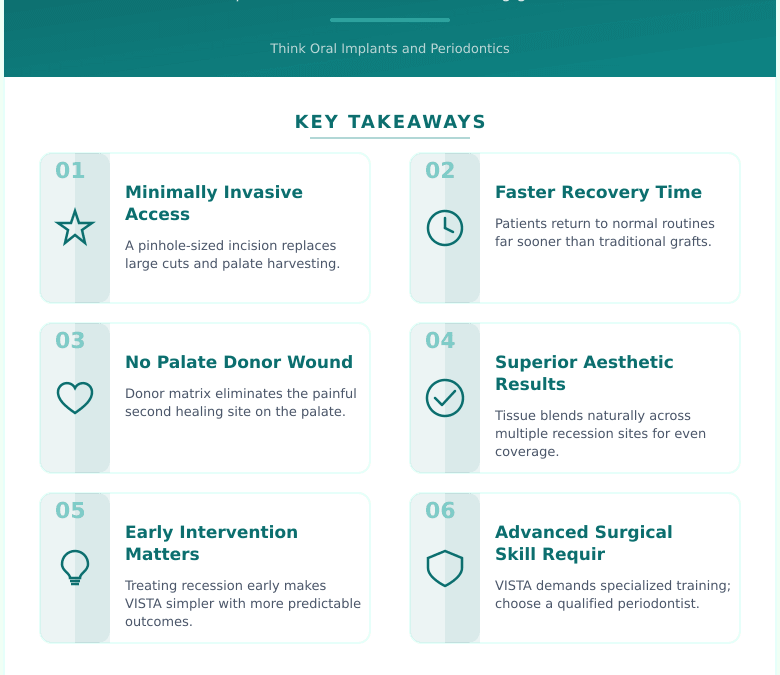
VISTA avoids a palate harvest wound – when donor matrix is used, you heal in one place, not two
Recovery is significantly shorter – most patients resume normal activity within a week
Multiple teeth can be treated in one session – reducing total time in the chair and total recovery periods
Early treatment is easier treatment – mild recession responds better and costs less to address
Verify insurance coverage before scheduling – medically necessary grafts are sometimes partially covered under dental plans
Ready to find out if you’re a candidate? Schedule a consultation with our team and get a clear picture of what treatment would look like for your specific situation. Explore our services page to see how VISTA fits alongside the broader range of periodontal care we provide.
- VISTA avoids a palate harvest wound – when donor matrix is used, you heal in one place, not two
- Recovery is significantly shorter – most patients resume normal activity within a week
- Multiple teeth can be treated in one session – reducing total time in the chair and total recovery periods
- Early treatment is easier treatment – mild recession responds better and costs less to address
- Verify insurance coverage before scheduling – medically necessary grafts are sometimes partially covered under dental plans
Frequently Asked Questions
How much does VISTA gum grafting cost with insurance?
The cost of VISTA gum grafting varies depending on the number of teeth treated, materials used, and your provider’s fees. Treating multiple adjacent teeth in one session can reduce the per-tooth cost. Dental insurance can cover a substantial portion, preauthorization is needed to ascertain coverage. Contact our office for specific pricing information.
How long does VISTA gum graft recovery take?
Recovery time after VISTA gum grafting varies by patient and the extent of treatment, but VISTA is generally associated with a faster return to normal routines than traditional connective tissue grafts. Strenuous physical activity and hard foods should be avoided for the first week.
Does VISTA gum grafting hurt?
The procedure itself is performed under local anesthesia, so patients feel pressure but no pain during surgery. Postoperative discomfort is generally mild and manageable with over-the-counter pain relievers. The absence of a palate harvest wound is the primary reason patients report less pain compared to traditional grafts.
How do I know if I need gum grafting?
Signs that gum grafting may be warranted include visible root exposure, tooth sensitivity to temperature, a longer-looking tooth compared to adjacent teeth, or a periodontist measurement showing recession of 2mm or more. A periodontal probe measurement at a professional evaluation gives you the clearest answer.
What is the difference between VISTA and the pinhole surgical technique?
Both use minimally invasive tunnel access, but VISTA incorporates a connective tissue or collagen graft material to provide structural support beneath the repositioned gum, while the pinhole technique relied primarily on tissue repositioning alone. The addition of a graft component in VISTA generally improves long-term root coverage stability.
Can recession come back after VISTA gum grafting?
Gum grafting corrects existing recession, but it does not eliminate the underlying causes, so recession can recur without addressing contributing factors. Proper brushing technique, a soft-bristle brush, bite guard use for grinders, and consistent periodontal maintenance are key to protecting the graft long term.
How do I verify a periodontist’s credentials before VISTA surgery?
Pennsylvania periodontists are licensed through the Pennsylvania State Board of Dentistry and board-certified professionals hold credentials through the American Board of Periodontology. You can verify any periodontist’s active license at the Pennsylvania Department of State’s license verification portal and confirm specialty certification at the American Academy of Periodontology’s member directory at perio.org.
What This Means for Your Gum Health Moving Forward
Gum recession rarely reverses on its own. By 2027, more practices across Pennsylvania are expected to offer tunnel-access techniques in line with patient demand. Getting evaluated now means more options, less complexity, and better results. Reach out to Think Oral Implants and Periodontics in Paoli to schedule your periodontal evaluation today.
This content is for educational purposes only and does not substitute for professional dental or medical advice. Always consult a licensed dental professional for diagnosis and treatment recommendations specific to your situation.
About the Author
The Think Oral Implants and Periodontics Team provides periodontal and implant care in Paoli, PA. For more information, visit our homepage or explore our services.