


Oral bacteria in systemic disease is the phenomenon where harmful microbes from the mouth enter the bloodstream and contribute to inflammation in the heart, brain, and other organs. Some studies have detected oral bacteria or bacterial DNA in arterial plaque, blood clots, and brain tissue, but this does not prove routine presence in all patients or confirm causation.
This guide focuses specifically on the oral-systemic connection, what it means for your health, and what you can do about it starting now.
How Mouth Bacteria Travel to Your Heart and Brain
Your mouth hosts over 700 species of bacteria. Most are harmless. But when gum disease (periodontitis) develops, the gum tissue becomes inflamed and its barrier function breaks down. That breakdown creates an opening.
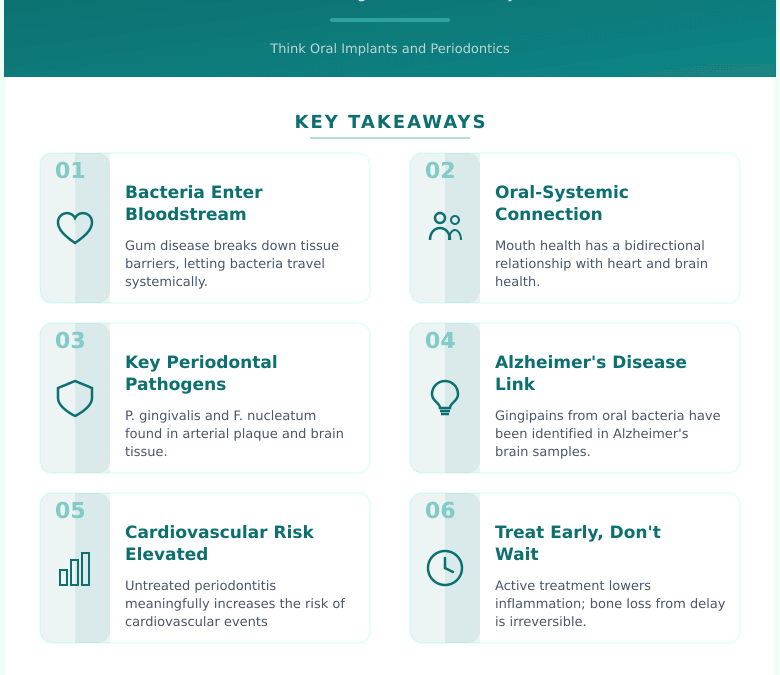
Every time you chew, brush, or even swallow, bacteria from infected gum tissue enter your bloodstream. From there, they travel. Researchers have identified Porphyromonas gingivalis and Fusobacterium nucleatum – both common periodontal pathogens – inside arterial plaque removed during cardiac procedures. The same species have been found in brain tissue from patients with Alzheimer’s disease.
Research supports an association between gum disease and an elevated risk of heart disease compared to those with healthy gums. Studies indicate that adults with untreated periodontitis face a meaningfully increased likelihood of experiencing cardiovascular events.
This is not a fringe theory. It is one of the most studied areas in medicine right now, and the evidence accumulated through 2026 has made it impossible to ignore.
Oral Bacteria and Systemic Disease: What the Research Shows
Porphyromonas gingivalis: A primary driver of periodontitis that produces enzymes called gingipains, which researchers have identified in brain samples from Alzheimer’s patients.
Fusobacterium nucleatum: A periodontal pathogen that appears to accelerate inflammatory processes once it escapes the mouth and has been studied in connection with systemic disease.
The most common pattern seen clinically is patients who present with persistent gum bleeding, bone loss around teeth, and chronic bad breath – and who also carry unmanaged cardiovascular risk factors. The connection is not coincidental.
Firms that implement this approach typically see patients who never connected their bleeding gums to their cardiologist’s concerns. That gap in awareness is exactly what makes this topic so important in 2026.
Thinking about this for your own situation? Contact usto talk through what an oral health evaluation can tell you – no pressure, just straight answers.
Treating Gum Disease vs. Ignoring It: A Real Comparison
Active Treatment vs. Watchful Waiting: Which Approach Works?
Where active treatment succeeds: Reduces bacterial load in the mouth, lowers systemic inflammatory markers (CRP), improves glycemic control in diabetic patients, and reduces the volume of oral pathogens entering the bloodstream.
Where active treatment fails: Requires consistent follow-through from the patient, may need multiple visits, and does not reverse existing arterial or neurological damage already caused by bacteria.
Where watchful waiting succeeds: Appropriate only for very mild gingivitis with improved home care. Avoids immediate cost outlay for patients with financial barriers.
Where watchful waiting fails: Periodontitis does not resolve on its own. Bacteria continue entering the bloodstream throughout the delay period. Bone loss is irreversible. Systemic inflammation compounds over time.
The verdict: For any patient with diagnosed gum disease – especially those with diabetes, cardiovascular risk, or a family history of cognitive decline – active treatment is the only defensible choice. Waiting does not pause the damage; it accelerates it.
Your Oral-Systemic Health Action Plan
- Step 1 – Get a Periodontal Evaluation: Ask your dental provider to measure your pocket depths and assess bone levels. This tells you whether bacteria have already caused structural damage below the gumline.
- Step 2 – Treat Active Disease First: Scaling and root planing (deep cleaning) removes bacterial deposits below the gumline. For more advanced cases, additional procedures may follow.
- Step 3 – Tell Your Physician: Share your gum disease diagnosis with your primary care doctor or cardiologist. Systemic inflammatory markers should be monitored alongside periodontal treatment.
- Step 4 – Commit to Maintenance Visits: After active treatment, periodontal maintenance every three to four months keeps bacterial levels suppressed and prevents re-infection.
- Step 5 – Reassess Annually: Patients with a history of periodontitis should work with their dental provider to determine an appropriate schedule for reassessment and imaging based on their individual risk and clinical needs.
- Brush twice daily for two full minutes using a soft-bristle brush
- Floss or use an interdental brush once daily – this is non-negotiable for controlling subgingival bacteria
- Avoid smoking, which dramatically worsens periodontal disease progression
- Manage blood sugar levels if diabetic – the diabetes-periodontitis relationship runs both directions
Pre-Appointment Checklist for Your Periodontal Visit
- ☐ List all current medications, including blood thinners and diabetes drugs
- ☐ Note any history of heart disease, diabetes, or cognitive concerns
- ☐ Bring recent bloodwork showing CRP or HbA1c levels if available
- ☐ Document symptoms: bleeding when brushing, loose teeth, persistent bad breath, gum recession
- ☐ Ask your dental provider specifically about the oral-systemic connection at your visit
Key Takeaways for Paoli-Area Patients in 2026
At Think Oral Implants and Periodonticsin Paoli, PA, our team focuses on exactly this kind of care – treating gum disease with an eye toward your whole-body health, not just your mouth. Patients come to us from Wayne, Berwyn, Malvern, Devon, Exton, Phoenixville, and across Chester County seeking periodontal care that takes the broader picture seriously. Explore our servicesto learn what treatment looks like from first evaluation through long-term maintenance.
- Oral bacteria are systemic bacteria – what lives in your gums does not stay in your gums
- Gum disease is the entry point – treating it reduces the bacterial traffic entering your bloodstream
- The heart and brain connection is evidence-based – not theoretical or speculative
- Waiting makes it worse – bone loss and systemic exposure compound over time without treatment
- Coordination between your dental and medical team matters – share your periodontal status with your physician
Frequently Asked Questions
Can gum disease actually cause heart disease?
Gum disease does not directly cause heart disease, but it contributes to the inflammatory environment in which cardiovascular disease develops. Oral bacteria that enter the bloodstream trigger systemic inflammation, and chronic inflammation is a primary driver of arterial plaque formation and cardiovascular risk.
Which oral bacteria are most dangerous to overall health?
Porphyromonas gingivalis and Treponema denticola are among the most studied oral pathogens linked to systemic disease. Both are commonly found in deep periodontal pockets and have been identified in cardiac and brain tissue in multiple research studies.
How much does periodontal treatment cost in 2026?
Scaling and root planing typically ranges from $500 to $1,500 across four quadrants in 2026, with surgical procedures ranging higher. Many dental insurance plans cover a portion of periodontal treatment, particularly when medical necessity is documented.
Does treating gum disease improve heart health?
Studies show that treating periodontitis lowers systemic inflammatory markers, including C-reactive protein, within weeks of completing active therapy. While it does not reverse existing arterial damage, it reduces ongoing bacterial exposure and inflammation.
How do I know if I have gum disease?
Common signs include bleeding gums when brushing, persistent bad breath, gum recession, loose teeth, and deep pockets detected during probing by your dental provider. Many people have periodontitis without obvious pain, which is why professional evaluation is essential.
How often should someone with a history of gum disease see a dentist?
Periodontal maintenance visits every three to four months are the standard recommendation for patients with a history of periodontitis. Annual twice-per-year cleanings are not sufficient to control bacterial recolonization in previously infected pockets.
Take the Next Step for Your Health
The connection between your oral health and your heart and brain is one of the clearest examples of why whole-body thinking matters in dental care. If you have not had a periodontal evaluation recently – or if you have been told you have gum disease and have not followed through on treatment – 2026 is the year to change that.
Ready to take the next step? Contact us todayfor straight answers and a real plan tailored to your health. Our team at Think Oral Implants and Periodontics in Paoli, PA is here to help you understand what your oral health means for your whole body.
This content is for educational purposes only and is not a substitute for professional medical or dental advice. If you are experiencing symptoms of a dental or medical emergency, seek care immediately.
About the Author
The Think Oral Implants and Periodontics Team , periodontal and implant care providers in Paoli, PA. For more information about our approach, visit our homepageor explore our services.