


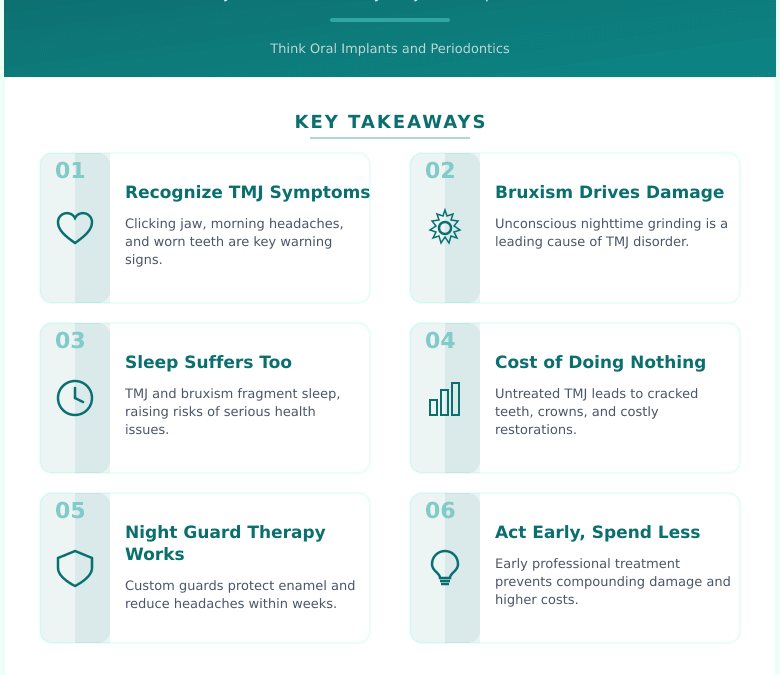
TMJ disorder is a condition affecting the temporomandibular joint (the hinge connecting your jaw to your skull) that causes pain, clicking sounds, and dysfunction in the jaw, face, and surrounding muscles. Left unaddressed, it can quietly erode your sleep, your bite, and the long-term health of your teeth.
This guide focuses specifically on recognizing TMJ disorder early, understanding what it costs when ignored, and knowing what treatment paths are available for patients in the greater Paoli, PA area.
You wake up with a tight jaw. There’s a dull throb behind your eyes. And when you open your mouth wide, there’s that click again. You’ve probably dismissed it as stress or bad sleep. But here’s the thing: that clicking jaw and morning headache are often your body’s way of signaling something more serious is going on with your bite and jaw joints.
What TMJ Disorder Actually Is
Temporomandibular joint disorder (TMD/TMJ): A group of conditions causing pain and dysfunction in the jaw joint and the muscles that control jaw movement.
Bruxism: The unconscious grinding or clenching of teeth, often during sleep, and one of the most common drivers of TMJ symptoms.
The National Institute of Dental and Craniofacial Researchrecognizes TMJ disorders as a significant public health concern affecting millions of Americans. Many go undiagnosed for years because the symptoms mimic other conditions like tension headaches, sinus pressure, or ear infections.
The temporomandibular joint handles chewing, speaking, and swallowing hundreds of times a day. When it’s not functioning correctly, the ripple effects reach far beyond your jaw.
Signs You Shouldn’t Keep Ignoring
The most common mistake patients make is waiting until the pain becomes unbearable before seeking care. By that point, the joint may already show wear, and tooth damage from bruxism may require restorative work on top of TMJ treatment.
- Clicking, popping, or grinding sounds when you open or close your mouth
- Morning headaches or facial pain that fades through the day
- Jaw stiffness or soreness after waking
- Pain when chewing, yawning, or opening wide
- Worn, flattened, or chipped teeth
- Neck and shoulder tension that won’t respond to massage
- Ringing in the ears (tinnitus) with no known cause
What Happens When TMJ Goes Untreated
Persistent jaw clenching puts significant stress on your teeth. Over months and years, this leads to cracked enamel, worn-down cusps, and eventually fractured teeth that need crowns, onlays, or in severe cases, extraction and replacement.
Sleep disruption is another hidden cost. Bruxism and TMJ pain fragment your sleep cycle. Recent data shows that chronic sleep disruption is linked to increased risk of cardiovascular disease, cognitive decline, and immune dysfunction. Your jaw problem isn’t just a jaw problem.
Thinking about this for your situation? Let’s talk. Contact usand we’ll walk you through your options – no pressure, no commitment required.
Treatment vs. No Treatment: What the Comparison Actually Looks Like
Night Guard Therapy vs. Doing Nothing: Which Approach Works?
Where night guard therapy succeeds: Protects enamel from bruxism damage, reduces muscle tension, improves sleep quality, and often reduces headache frequency significantly within weeks.
Where night guard therapy falls short: It manages symptoms rather than correcting the underlying bite problem. Custom devices require professional fitting and upkeep. Over-the-counter versions often worsen jaw positioning.
Where doing nothing succeeds: Zero upfront cost, no appointments needed.
Where doing nothing fails: Tooth damage accumulates. Pain worsens. Sleep degrades. Restorative costs down the road far exceed early intervention costs.
The verdict: Early, professionally guided treatment consistently prevents the compounding damage that makes TMJ problems expensive and complex. The longer you wait, the more you’ll spend to undo what time and pressure have done.
These are general industry ranges and not representative of any specific provider’s fees. Costs vary based on case complexity and individual treatment needs.
Your TMJ Action Plan
- Step 1 – Document your symptoms: Track when pain occurs, what triggers it, and how long it lasts. This information is critical for accurate diagnosis.
- Step 2 – Schedule a clinical evaluation: A dental professional can assess joint function, tooth wear, and bite alignment. Imaging may be used to examine the joint in detail.
- Step 3 – Confirm the diagnosis: TMJ disorders can overlap with other conditions. A thorough assessment rules out sinus, ear, or neurological causes.
- Step 4 – Start conservative care first: Most cases respond well to night guards, jaw exercises, and dietary changes (soft foods, avoiding wide opening). Surgery is rarely needed early on.
- Step 5 – Protect existing teeth: If bruxism has caused wear, discuss restoration timing with your provider before damage worsens.
- Step 6 – Follow up and adjust: TMJ treatment often requires fine-tuning. Stick with the follow-up schedule your provider recommends.
Pre-Appointment Checklist
The team at Think Oral Implants and Periodontics, serving patients in Paoli and surrounding Chester County communities including Berwyn, Wayne, Malvern, Devon, and Exton, can help evaluate jaw health as part of a broader picture of your oral health. See our services pagefor more on what we offer.
- ☐ List all symptoms and when they started
- ☐ Note any recent changes in stress levels or sleep patterns
- ☐ Bring a list of current medications (some contribute to bruxism)
- ☐ Note any history of jaw injury or dental work
- ☐ Write down questions about treatment options and costs
Frequently Asked Questions
How do I know if my jaw clicking is actually TMJ disorder?
Jaw clicking alone doesn’t confirm TMJ disorder – it’s the combination of clicking with pain, stiffness, or headaches that points toward a diagnosis. A clinical evaluation is the only way to confirm it. Clicking without pain is common and may not require treatment.
Does dental insurance cover TMJ treatment?
Coverage varies widely – some dental plans cover night guards and diagnostic imaging, while others classify TMJ treatment as medical rather than dental. Checking with both your dental and medical insurer before starting treatment is worth doing, since medical plans sometimes cover a portion of costs.
Can TMJ disorder go away on its own?
Mild cases sometimes improve with stress reduction and soft-food diets, but moderate to severe TMJ disorder rarely resolves without intervention. Without addressing the bite or muscle dysfunction driving it, symptoms typically return and worsen over time.
How long does TMJ treatment take?
Most patients notice meaningful symptom improvement within 4-8 weeks of consistent conservative treatment. Full resolution, particularly when bite correction or muscle retraining is involved, can take 3-6 months.
Is bruxism the same as TMJ disorder?
Bruxism (teeth grinding) and TMJ disorder are related but not identical – bruxism is a behavior that frequently causes or worsens TMJ symptoms. Many patients have both, and treating one without addressing the other often leads to incomplete relief.
What should I avoid if I have TMJ pain?
Hard, chewy, or crunchy foods put the most stress on the joint and should be minimized during flare-ups. Chewing gum, biting nails, and resting your chin on your hand are also habits that load the joint unnecessarily.
When does TMJ disorder require a professional?
If conservative treatment hasn’t reduced symptoms after 6-8 weeks, or if you’re experiencing significant joint locking, a professional evaluation is appropriate. Periodontists and oral health providers with specific training in occlusion and jaw function can assess cases that go beyond routine care. The American Dental Associationprovides guidance on finding qualified providers.
What This Means for You
A clicking jaw and a morning headache aren’t just inconveniences. They’re signals worth taking seriously – especially before the costs, in both dollars and dental health, start stacking up. Early evaluation is low-risk and often leads to straightforward, affordable solutions.
Ready to find out what’s actually going on? Get more informationfrom our team at Think Oral Implants and Periodontics, located at 250 W. Lancaster Avenue, Suite 215, in Paoli, PA. We’ll give you straight answers about what we’re seeing and what your options look like – no pressure, no unnecessary recommendations.
This content is for informational purposes only and is not a substitute for professional dental or medical advice. If you are experiencing severe jaw pain, inability to open or close your mouth, or other acute symptoms, seek prompt professional evaluation.
About the Author
The Think Oral Implants and Periodontics Team , serving patients in Paoli, PA and the surrounding Chester County area. For more information about our approach to oral health, visit our homepageor explore our services.