


Peri-implantitis is a destructive inflammatory condition affecting the gum and bone tissue surrounding a dental implant. Left untreated, it causes progressive bone loss that can make implant failure unavoidable – and emerging research now suggests certain viruses may accelerate the process.
This guide focuses specifically on peri-implantitis risk, detection, and what patients with dental implants need to know to protect their investment.
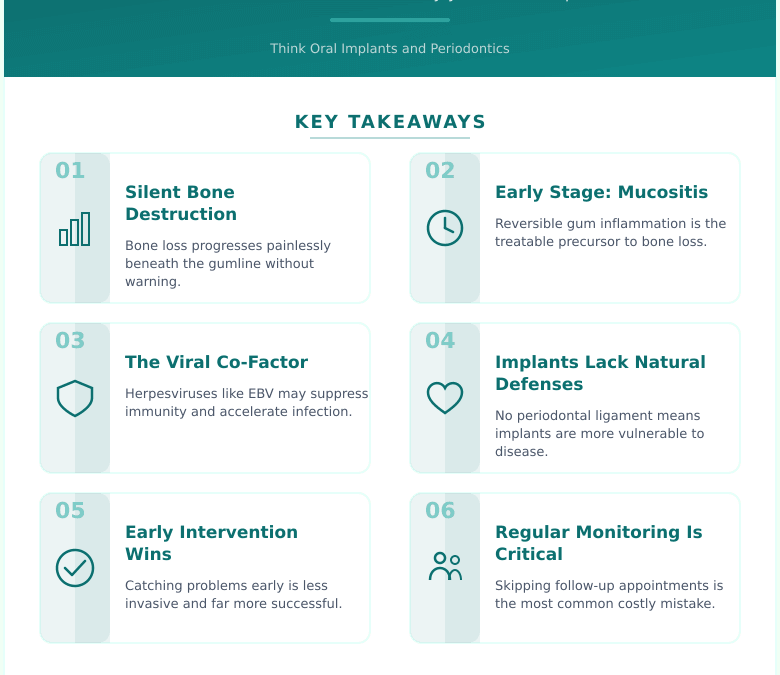
Here’s what makes peri-implantitis so dangerous. Unlike a toothache that demands your attention, this condition frequently advances without obvious symptoms. You might feel nothing while bone loss is quietly happening beneath the gum line. According to the National Institute of Dental and Craniofacial Research, implant-related complications affect a meaningful percentage of patients, with peri-implantitis being among the most common long-term concerns.
Why Peri-Implantitis Catches People Off Guard
Most patients assume that once an implant integrates successfully, the hard work is done. That’s understandable. But an implant doesn’t have the natural defenses a real tooth root has. There’s no periodontal ligament acting as a shock absorber and early-warning system. The tissue around an implant is structurally different – and more vulnerable to certain bacterial and, it turns out, viral activity.
The condition often begins as peri-implant mucositis (reversible inflammation limited to the gum tissue). If that earlier stage isn’t addressed, it can convert into full peri-implantitis with bone involvement – and that’s where the damage becomes difficult to reverse.
Peri-implant mucositis: Reversible inflammation of the soft tissue surrounding an implant, considered the precursor stage to peri-implantitis.
The most common mistake patients make is skipping follow-up appointments after implant placement. Early warning signs get missed, and what could have been a simple intervention turns into a complex treatment challenge.
Thinking about this for your situation? Contact us for a straightforward assessment – no pressure, just answers about what’s happening with your implant.
The Viral Connection – What the Research Actually Says
This is where things get genuinely interesting. Recent data from multiple peer-reviewed studies points to herpesviruses – particularly Epstein-Barr virus (EBV) and human cytomegalovirus (HCMV) – appearing at elevated rates in peri-implantitis sites compared to healthy implant sites.
The working theory is that viral activity may suppress local immune defenses, creating an environment where destructive bacteria thrive more aggressively. It doesn’t mean a virus causes peri-implantitis on its own. It may act as a co-factor – amplifying bacterial infection and accelerating bone breakdown.
This has real clinical implications. It suggests that some cases of peri-implantitis may be more aggressive in patients with certain viral histories, and it opens the door to more targeted treatment approaches as research continues. As of early 2026, this remains an active area of study, but the signal is consistent enough that clinicians are paying attention.
Professional dental organizations and periodontal professionals consistently support rigorous periodontal monitoring after implant placement as the standard of care for catching problems early – viral co-factors or not.
Early Treatment vs. Advanced Peri-Implantitis: Which Approach Works?
Where early intervention succeeds: Catching peri-implant mucositis or mild peri-implantitis means treatment is less invasive, costs less, and success rates for halting bone loss are significantly higher. Non-surgical debridement, improved home care, and possibly antimicrobial agents can often stabilize the condition.
Where early intervention fails: If the patient doesn’t follow through with maintenance visits, even successful early treatment can relapse.
Where advanced treatment succeeds: Surgical intervention – including bone grafting and implant surface decontamination – can rescue implants that have suffered moderate bone loss if addressed before the implant becomes mobile.
Where advanced treatment fails: Once bone loss is severe and the implant is unstable, removal is often the only option. At that stage, costs and recovery timelines increase substantially.
The verdict: Early detection wins every time. The treatment gap between catching peri-implantitis at stage one versus stage four is enormous – both in complexity and cost.
Treatment costs vary based on clinical complexity, materials, and provider location. Contact your dental provider for specific pricing information. These are not the fees of any specific practice.
Warning Signs You Should Not Ignore
Any one of these signs warrants a call to your provider. Two or more together? Don’t wait.
- Bleeding or swelling around the implant site
- Redness or puffiness of gum tissue near the implant
- Pain or discomfort when pressing on the implant area
- Implant that feels loose or shifted
- Foul taste or odor that doesn’t resolve with brushing
- Visible recession of gum tissue around the implant crown
Your Peri-Implantitis Action Plan
- Step 1 – Attend every maintenance appointment: Peri-implant maintenance (typically every 3-6 months) is not optional. This is when early problems get caught before they escalate.
- Step 2 – Report symptoms immediately: Don’t wait for your next scheduled visit if you notice bleeding, swelling, or looseness around the implant.
- Step 3 – Get a probing and X-ray baseline: Bone levels around implants should be measured and documented regularly so changes can be tracked over time.
- Step 4 – Optimize home care: Water flossers, interdental brushes, and implant-safe floss work better than standard floss for cleaning around implant crowns.
- Step 5 – Discuss your medical history honestly: Conditions like diabetes, smoking history, and certain medications affect peri-implant health. Your provider needs the full picture.
Pre-Appointment Checklist for Implant Patients
At Think Oral Implants and Periodontics, patients in Paoli, PA and the surrounding communities – including Berwyn, Malvern, Wayne, Villanova, Ardmore, Devon, and Exton – have access to periodontal monitoring designed to catch peri-implantitis before it reaches the point of no return. Visit our services pageto learn more about our approach to implant maintenance and periodontal care.
- ☐ List any changes in medications since your last visit
- ☐ Note any symptoms – even minor ones – you’ve noticed around the implant
- ☐ Bring your implant records if you had the procedure done elsewhere
- ☐ Ask about X-ray comparison to your baseline post-placement images
- ☐ Ask specifically whether bone levels around each implant appear stable
Frequently Asked Questions
How common is peri-implantitis?
Studies estimate that peri-implantitis affects between 10% and 20% of dental implants within 10 years of placement. The actual rate varies based on patient health, maintenance habits, and implant characteristics. Early-stage mucositis is even more common, making regular monitoring essential.
Can peri-implantitis be cured?
Early-stage peri-implantitis can often be halted and managed successfully, though complete reversal of bone loss typically requires surgical intervention. The goal of treatment is to stop progression and stabilize the implant, not necessarily to restore bone to original levels.
Does peri-implantitis always hurt?
Not always – and that’s exactly what makes it dangerous. Many patients experience no significant pain until the condition is advanced. Routine clinical monitoring is the only reliable way to catch it early.
Is the viral connection to peri-implantitis proven?
Research published through 2025 and continuing into 2026 shows a consistent association between herpesviruses and peri-implantitis sites, though the precise causal relationship is still under investigation. Clinicians treat it as a contributing factor, not a standalone cause.
How is peri-implantitis diagnosed?
Diagnosis involves clinical probing to measure pocket depth around the implant, radiographic imaging to assess bone levels, and visual examination of tissue health. Comparing current X-rays to baseline images taken at implant placement is especially informative.
What increases my risk for peri-implantitis?
Key risk factors include a history of periodontal disease, smoking, poorly controlled diabetes, inadequate oral hygiene, and skipped maintenance appointments. Implant design and placement precision also play a role that varies by case.
How is peri-implantitis treated?
Treatment ranges from non-surgical cleaning and antimicrobial therapy for early cases to surgical debridement, bone grafting, and implant surface decontamination for advanced cases. In severe situations where the implant is mobile, removal may be necessary.
What This Means for Implant Patients Right Now
The bottom line is straightforward. Dental implants are built to last decades – but only with the right follow-up care. Peri-implantitis is preventable in many cases, and even when it develops, catching it early makes all the difference. The viral connection adds an interesting layer to how this condition works, and future treatment protocols may reflect that understanding.
Don’t assume your implant is fine just because it doesn’t hurt. Schedule a dedicated implant health check, ask for bone-level imaging, and get honest answers about where things stand.
This content is for educational purposes only and does not substitute for professional dental or medical advice. Always consult a qualified dental provider for diagnosis and treatment decisions.
Ready to take the next step? Contact us today for straight answers about your implant health. The sooner you know, the more options you have.
About the Author
The Think Oral Implants and Periodontics Team , serving patients in Paoli, PA and the greater Chester County area. For more information about our approach to implant and periodontal care, visit our homepageor explore our services.