


AI-powered gum disease detection is the use of machine-learning algorithms to analyze dental X-rays and identify signs of periodontal disease with measurable precision. Recent clinical data suggests these systems can flag bone loss patterns and early gum disease markers that trained clinicians may overlook during routine review.
This guide focuses specifically on what AI-assisted periodontal diagnosis means for patients seeking accurate, early detection of gum disease in 2026.
For most patients, a dental X-ray has always felt like a moment of trust. You sit still, the image is taken, and a trained eye reviews it. But that process is changing fast. AI-powered gum disease detection tools are now being integrated into periodontal practices, and the accuracy numbers are hard to ignore. Early-stage periodontal bone loss can be difficult to identify during standard clinical examination, and AI-assisted analysis adds a measurable layer of consistency to that review. AI changes that equation significantly.
At Think Oral Implants and Periodonticsin Paoli, PA, this shift in diagnostic technology directly affects how patients are evaluated and how early treatment can begin.
What AI-Powered Gum Disease Detection Actually Does
AI-powered gum disease detection: A machine-learning system trained on thousands of dental radiographs to identify bone level changes, calculus deposits, and periodontal pocket indicators that suggest active or developing gum disease.
Here is the thing most patients do not realize: gum disease progresses silently. By the time bleeding or sensitivity becomes obvious, the disease has often been active for months. AI radiology tools scan X-ray images and measure bone density, crest height, and furcation involvement with a level of consistency a human eye simply cannot replicate across hundreds of images daily.
Some AI models have reported sensitivity above 90% for periodontal bone-loss detection, but performance varies widely and direct comparisons to routine visual review should be stated with the same metric and study context. That gap matters enormously for patients whose disease is caught in Stage 1 versus Stage 3.
The most common mistake clinicians see is relying solely on probing depths without cross-referencing radiographic bone levels. AI closes that gap by adding a consistent, quantified layer to what the X-ray shows.
AI Diagnosis vs. Traditional Clinical Review: Which Approach Works?
Where AI diagnosis succeeds: Consistent measurement of bone levels across every radiograph, detection of early bone loss changes that may be difficult to identify through visual review alone, reduced examiner fatigue bias, and faster flagging of high-risk areas for clinician review.
Where AI diagnosis falls short: AI cannot assess soft tissue texture, patient-reported pain history, or systemic health context without integration with clinical notes. It also requires calibrated digital X-ray input to perform accurately.
Where traditional clinical review succeeds: Experienced clinicians interpret systemic risk factors, patient anxiety, and bleeding patterns that no algorithm captures. Clinical judgment connects radiographic findings to real patient circumstances.
Where traditional clinical review falls short: Human review is subject to fatigue, inconsistency between appointments, and the natural tendency to weight visual salience over subtle early-stage change.
The verdict: The strongest diagnostic model in 2026 combines both. AI flags what the image shows objectively. The clinician interprets what it means for that specific patient. Neither alone is as reliable as both together.
Thinking about whether your current dental X-ray review includes AI-assisted analysis? Contact usand we will walk you through what your diagnostic process includes, no pressure.
What This Means for Your Periodontal Treatment Path
Earlier detection is not just a technical win. It changes what treatment you need. A patient diagnosed at Stage 1 typically responds well to scaling and root planing, a non-surgical cleaning that removes bacterial deposits below the gum line. A patient caught at Stage 3 may require surgical intervention, longer recovery, and more visits.
Scaling and root planing: A deep-cleaning procedure performed under local anesthesia that removes calculus and bacterial biofilm from root surfaces to halt periodontal disease progression.
According to the American Dental Association, nearly half of adults over 30 show signs of periodontal disease, yet many are unaware because early symptoms are mild. AI-assisted detection addresses exactly this awareness gap.
Practices in communities like Paoli, Berwyn, Wayne, Malvern, Devon, Exton, and throughout Chester County are beginning to adopt these tools as part of standard periodontal evaluation. Patients who live in the Main Line area and surrounding communities now have access to this technology without traveling to a major academic center.
Your AI-Assisted Gum Disease Evaluation Action Plan
Pre-appointment checklist to bring to your evaluation:
- Step 1 – Request updated radiographs: AI analysis generally requires suitable digital radiographs, but how recent the images must be depends on the clinic’s workflow and the system used. Older film-based images cannot be processed by most AI platforms.
- Step 2 – Ask about AI integration: Confirm your periodontist uses AI-assisted radiograph analysis as part of their diagnostic workflow, not just visual review alone.
- Step 3 – Review bone level data: Ask your clinician to show you the AI-generated bone level measurements and compare them to your previous X-rays if available.
- Step 4 – Discuss staging and grading: Ensure your diagnosis uses the 2026 AAP/EFP staging and grading system, which classifies disease severity from Stage 1 through Stage 4.
- Step 5 – Build a monitoring schedule: Patients with diagnosed periodontal disease typically need re-evaluation every 3-4 months. AI analysis at each visit tracks whether bone levels are stable or progressing.
- ☐ List of current medications, including blood thinners and blood pressure drugs
- ☐ Recent medical history including diabetes, cardiovascular conditions, or pregnancy
- ☐ Previous dental X-rays on CD or digital transfer if available
- ☐ Insurance card and referral from general dentist if required
- ☐ Notes on any symptoms including bleeding, sensitivity, or tooth mobility
Key Takeaways for Patients in 2026
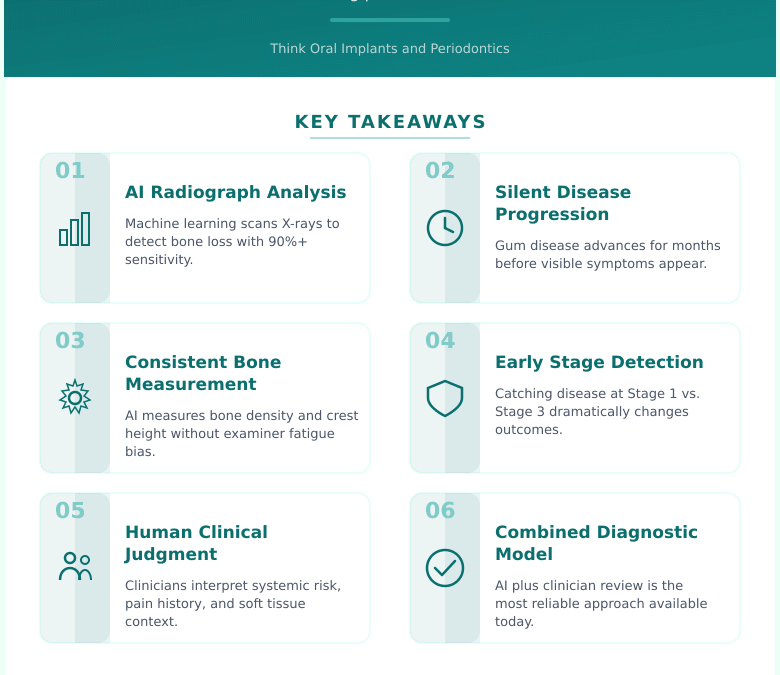
- AI detection is more accurate for early bone loss – catching disease at Stage 1 dramatically reduces treatment complexity.
- Combined AI and clinical review is the current standard – technology supports the clinician but does not replace judgment.
- Nearly 50% of adults have periodontal disease – most are undiagnosed until disease has already progressed.
- Your X-ray tells more than you think – AI reads bone density changes invisible to routine visual inspection.
- Earlier diagnosis means less invasive treatment – non-surgical options remain available at Stage 1 and Stage 2.
Frequently Asked Questions
How does AI detect gum disease in a dental X-ray?
AI analyzes pixel-level bone density patterns in digital radiographs to identify alveolar bone loss and calculus deposits associated with periodontal disease. The system compares bone crest levels against reference values and flags deviations that suggest active disease, even when the changes are subtle and difficult to detect visually.
Is AI-assisted periodontal diagnosis covered by dental insurance?
Most dental insurance plans in Pennsylvania cover the underlying diagnostic X-rays, though AI analysis as a standalone service may not yet carry a separate billing code. Ask your periodontist how AI analysis is integrated into the diagnostic visit and what your plan covers for complete periodontal evaluation.
Can AI detect gum disease earlier than my regular dentist?
In controlled studies, AI systems detect early-stage bone loss with significantly higher sensitivity than standard clinical review alone. This does not mean your dentist is missing obvious disease. It means AI catches subtle changes that are genuinely difficult to see visually at early stages.
How often should periodontal X-rays be taken?
Patients with active or treated periodontal disease typically need updated radiographs every 12-24 months depending on disease stability. Your periodontist will recommend a schedule based on your staging, grading, and response to treatment.
What is the difference between a periodontist and a general dentist for gum disease?
A periodontist completes three additional years of post-dental school training focused exclusively on the supporting structures of teeth, including diagnosis and surgical treatment of gum disease. General dentists manage mild cases but typically refer moderate to severe periodontal disease to a periodontist for focused care.
Does AI replace the periodontal probing exam?
No. AI radiograph analysis and clinical probing measure different things and work best together. Probing measures pocket depths and bleeding on pressure. AI measures radiographic bone levels. Both are needed for an accurate periodontal diagnosis.
What happens if gum disease is caught early with AI?
Early-stage periodontal disease caught at Stage 1 or Stage 2 often responds fully to non-surgical treatment including scaling and root planing and improved home care. Patients treated early typically avoid surgery, preserve more natural bone, and maintain teeth long-term with regular monitoring.
What Comes Next for Paoli-Area Patients
AI-assisted periodontal diagnosis is not a future technology. It is available now, and practices using it are delivering measurably more accurate early detection. If your last gum evaluation relied only on visual review and probing, it may be worth asking whether AI radiograph analysis was part of the process.
The team at Think Oral Implants and Periodontics, located at 250 W. Lancaster Avenue in Paoli, PA, works with patients from across Chester County and the Main Line to provide thorough periodontal evaluation. If you have concerns about gum disease or want to know whether your diagnosis reflects current diagnostic standards, reach out directly.
Ready to get a clearer picture of your gum health? Contact us todayto schedule a complete periodontal evaluation. Catching gum disease early is always better than treating it late.
This content is intended for educational purposes and does not substitute for professional dental or medical advice. Always consult a licensed dental professional for diagnosis and treatment recommendations specific to your condition.
About the Author
The Think Oral Implants and Periodontics Team , periodontal and implant care providers in Paoli, PA. For more information about our approach, visit our homepageor explore our services.