


Gum disease in seniors is a chronic bacterial infection of the tissues supporting your teeth that affects the majority of adults over 65, often without any obvious pain or warning signs. Left unaddressed, it connects to serious systemic conditions including heart disease, diabetes complications, and cognitive decline.
This guide focuses specifically on why gum disease is so prevalent in older adults, why it stays hidden for so long, and what you can do right now to protect your oral and overall health.
The Numbers That Should Concern Every Senior in Pennsylvania
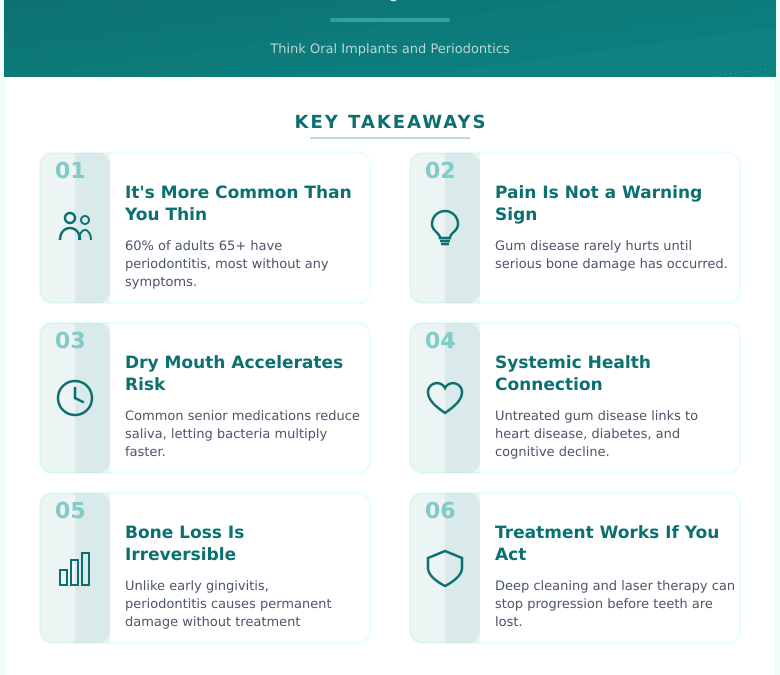
According to CDC oral health data, about 60% of adults 65 and older had periodontitis in 2009-2014. That is not a small margin. That is most people in that age group walking around with an active infection they cannot see or feel.
Here in the Paoli area and across Chester County, that statistic plays out every day. People come in for routine cleanings and discover bone loss that started years ago. The infection did not announce itself. It just progressed.
According to the National Institute of Dental and Craniofacial Research, severe periodontitis affects nearly 9% of adults overall, but that rate climbs sharply after age 65.
Gingivitis: The early, reversible stage of gum disease where gums bleed and swell but bone loss has not yet begun.
Periodontitis: The advanced, irreversible stage where bacteria destroy the bone and connective tissue holding teeth in place.
Why Gum Disease in Seniors Stays Hidden So Long
The most common mistake people make is waiting for pain before calling a dentist. Gum disease rarely hurts in its early or middle stages. Here is what actually happens:
The pattern we see most often is this: a patient in their late 60s or 70s comes in having skipped routine care for a few years. They feel fine. But the X-rays tell a completely different story.
Age-related changes make this worse. Medications common in older adults, including antihypertensives, antihistamines, and antidepressants, frequently cause dry mouth. Saliva protects your gums by neutralizing bacteria. Less saliva means bacteria multiply faster.
- Gums slowly pull back from teeth, exposing roots
- Bone loss happens gradually, often undetectable without X-rays
- Bleeding during brushing gets dismissed as normal
- Tooth sensitivity gets blamed on toothpaste or age
- Bad breath gets masked with mints
Treating Gum Disease vs. Ignoring It: What Actually Happens
Gum Disease Treatment Options vs. Doing Nothing
Where treatment succeeds: Scaling and root planing (a deep-cleaning procedure) removes bacterial deposits below the gumline. Laser-assisted therapy reduces bacteria with less discomfort than traditional surgery. Maintenance visits every three to four months slow or stop disease progression.
Where treatment has limits: Bone that has been lost cannot fully regenerate without grafting procedures. Treatment requires commitment to ongoing maintenance. Costs can add up without insurance coverage.
Where doing nothing leads: Continued bone loss, eventual tooth loss, and increasing systemic inflammation linked to cardiovascular and metabolic conditions.
Where doing nothing fails completely: Once teeth are lost, replacement options like implants become more complex and costly. Bone deficiency may disqualify some patients from standard implant placement.
The verdict: Treating gum disease at any stage is better than waiting. Even moderate periodontitis responds well to non-surgical treatment when caught before advanced bone loss occurs.
Treatment costs vary widely based on geography, provider, insurance coverage, and case complexity. Contact your dental provider for specific fee information.
Thinking about this for your situation? Let’s talk. Contact usto walk through your options with no pressure.
Your Gum Disease Action Plan
- Step 1 – Get a full periodontal evaluation: Ask specifically for periodontal probing depths and bone level X-rays. A standard cleaning appointment does not always include this.
- Step 2 – Review your medications: Tell your dental provider every medication you take. Dry-mouth side effects change your risk profile significantly.
- Step 3 – Start or upgrade your home care: An electric toothbrush and daily flossing or water flosser use reduces bacterial load between visits.
- Step 4 – Schedule periodontal maintenance every 3-4 months: Once you have had periodontitis, twice-yearly cleanings are not enough. Regular maintenance at shorter intervals helps keep bacterial levels below the gumline under control.
- Step 5 – Address systemic connections: If you have diabetes or cardiovascular disease, share your periodontal status with your medical doctor. The relationship runs both ways.
What to Bring to Your First Periodontal Appointment
- ☐ Full list of current medications and dosages
- ☐ Any recent dental X-rays from another provider
- ☐ Your dental insurance card and ID
- ☐ Notes about symptoms: bleeding, sensitivity, loose teeth, or bad breath
- ☐ Your medical history including systemic conditions like diabetes or heart disease
Key Takeaways for Seniors in 2026
- Pain is not a reliable indicator – most gum disease causes no pain until it is advanced
- Annual cleanings alone are not enough – periodontal evaluation requires probing and specific X-rays
- Dry mouth from medications accelerates risk – this is one of the most underrecognized factors in older adults
- Early treatment is dramatically cheaper – gingivitis costs a fraction of what advanced periodontitis treatment requires
- Systemic health and gum health are connected – 2026 research continues to strengthen those links
Serving Patients Across Chester County and the Main Line
At Think Oral Implants and Periodontics, we serve patients from Paoli, Malvern, Wayne, Berwyn, Devon, Exton, and the broader Chester County area. Our practice is located at 250 W. Lancaster Avenue, Suite 215, Paoli, PA 19301, which puts us right in the center of the Main Line communities where so many older adults live and receive care.
For a full overview of what we offer, visit our services page.
Frequently Asked Questions
How does a dentist diagnose gum disease in older adults?
Diagnosis requires periodontal probing, where a small instrument measures the depth of pockets between your gums and teeth, along with dental X-rays to assess bone levels. Pockets deeper than 3mm and visible bone loss on X-rays are primary indicators. Symptoms like bleeding gums, recession, and tooth mobility also factor into diagnosis.
Is gum disease treatment covered by dental insurance?
Most dental insurance plans cover a portion of scaling and root planing, typically at 50-80% after the deductible, though coverage varies significantly by plan. Medicare Part A and Part B do not cover most dental services, so seniors often rely on standalone dental insurance or pay out of pocket. Always verify your specific plan before treatment.
Can gum disease come back after treatment?
Yes, periodontitis can recur if maintenance care is not maintained, which is why periodontal patients typically need cleanings every three to four months rather than twice yearly. Without consistent maintenance, bacterial levels below the gumline can rebuild over time. Consistent maintenance is the difference between stabilizing the disease and letting it progress again.
What is the link between gum disease and heart disease?
Research shows that the same bacteria found in infected gum tissue have been identified in arterial plaque associated with cardiovascular disease. Chronic gum inflammation also raises systemic inflammatory markers like CRP that are linked to heart attack risk. The relationship is correlational and under active study in 2026, but the connection is taken seriously by both dental and medical communities.
Does losing teeth mean gum disease has gotten too severe to treat?
Not necessarily. Even patients who have lost teeth to periodontal disease can have the remaining infection treated and stabilized. If implants are being considered to replace lost teeth, treating active gum disease first is essential, since uncontrolled infection can cause implant failure.
How long does gum disease treatment take?
Non-surgical treatment like scaling and root planing typically takes two to four appointments spread over a few weeks, followed by a re-evaluation visit about four to six weeks later. More advanced cases involving surgery require additional healing time. Ongoing maintenance continues indefinitely after that.
Your Next Step Starts Here
Gum disease does not wait and it does not announce itself. If you are over 65 and have not had a dedicated periodontal evaluation recently, this year is the right time to change that. Catching even moderate disease now saves bone, saves teeth, and very likely protects more than just your smile.
Ready to take the next step? Contact us todayat Think Oral Implants and Periodontics in Paoli, PA for straight answers and real guidance on what your gum health actually looks like right now.
This content is for educational purposes only and is not a substitute for professional dental or medical advice. Always consult a qualified dental provider for diagnosis and treatment recommendations specific to your situation.
About the Author
The Think Oral Implants and Periodontics Team , periodontal and implant dental care in Paoli, PA. For more information about our approach, visit our homepageor explore our services.