


Regenerative implant technology is a class of bone and tissue restoration methods that use biological materials, including stem cells and bioprinted scaffolds, to rebuild jaw structure before or during dental implant placement. These approaches aim to reduce healing time, improve implant stability, and eliminate the need for traditional bone grafts taken from a patient’s own body.
This guide focuses specifically on regenerative implant advances arriving in 2026 and what they mean for patients considering dental implants in the greater Philadelphia area.
If you’ve been told you don’t have enough bone for implants, or if a previous implant failed, these developments are worth knowing about. The science has moved fast since 2025, and patients who stayed informed are now walking into consultations with better questions and better outcomes. At Think Oral Implants and Periodonticsin Paoli, PA, we follow these research shifts closely because they directly affect how we plan treatment for our patients.
Why Bone Loss Makes Implants Complicated
Bone loss is the single most common reason people are told they’re not candidates for dental implants. It happens after tooth extraction, from gum disease, or just from years of wearing a denture. The jaw shrinks where teeth are missing because it no longer receives the stimulation it needs.
Traditional solutions involve bone grafting, either from another part of your mouth, a cadaver source, or a synthetic material. These grafts work, but they add surgery time, recovery weeks, and cost. Bone grafting procedures are performed widely across the United States each year in connection with implant treatment.
That reality tells you how common the problem is. The regenerative approaches arriving in 2026 are trying to make the solution faster and less invasive.
What Stem Cell Therapy Actually Does in Implant Treatment
Stem cell therapy in implant dentistry: A process where mesenchymal stem cells, often derived from the patient’s own fat tissue or bone marrow, are introduced to a graft site to accelerate bone formation and reduce rejection risk.
Here’s what this looks like in practice. Instead of placing a block of donor bone and waiting six months, a clinician can introduce stem cells alongside a scaffold material. Those cells differentiate into bone-forming cells called osteoblasts. The result is faster, more predictable bone fill.
Emerging research into autologous stem cell protocols (using your own cells) shows promising results for graft outcomes. The pattern we see consistently in the literature: patients with more biological regeneration respond better long-term than patients relying on passive synthetic materials alone.
The most common mistake in planning implant cases today is underestimating how much the regenerative foundation matters. The implant post is almost the easy part. Getting the bone right is where outcomes are actually decided.
Thinking about whether this applies to your situation? Contact usand we’ll walk through your bone health, your imaging, and your realistic options. No pressure, just straight answers.
3D-Printed Bone: From Lab to Clinic
3D-bioprinted bone scaffold: A patient-specific structure printed from biocompatible materials, sometimes seeded with stem cells, designed to match the exact geometry of a patient’s bone defect and guide new bone growth.
This is where things get genuinely interesting. Bioprinting technology now allows a clinician to take a CBCT (cone beam CT) scan, model the exact shape of your bone defect, and print a scaffold that fits it precisely. That scaffold acts as a temporary framework while your own cells move in and create real bone.
Patient-specific scaffolds made from biocompatible materials like hydroxyapatite and tricalcium phosphate are an active area of clinical research and development, as both materials are gradually resorbed as new bone replaces them. The precision these approaches offer reduces surgical guesswork and may shorten the period before an implant can be placed.
Traditional Bone Graft vs. Regenerative Protocol: Which Approach Works?
Where traditional grafts succeed: Predictable results, lower cost, wide availability, decades of clinical data behind them.
Where traditional grafts fall short: Longer healing timelines, donor site morbidity when harvesting from the patient, less precision for complex defects.
Where regenerative protocols succeed: Faster integration, patient-specific fit, lower biological rejection risk, better outcomes for large or irregular defects.
Where regenerative protocols fall short: Higher upfront cost, limited availability outside specialty practices, still accumulating long-term data.
The verdict: For straightforward minor bone deficiency, traditional grafts remain a solid and cost-effective choice. For patients with significant bone loss, failed prior grafts, or complex anatomy, regenerative approaches offer a meaningful clinical advantage in 2026.
See how our clinical approach compares – explore our servicesto understand how we evaluate each case individually.
Your Regenerative Implant Action Plan
- Step 1 – Get a CBCT Scan: A standard 2D X-ray won’t show bone volume accurately. CBCT imaging gives your provider a 3D map of your jaw structure and reveals exactly how much bone is available.
- Step 2 – Review Your Bone Health: Ask specifically about bone density and width at the implant site. If bone loss is present, ask whether stem cell or scaffold options are available at that practice.
- Step 3 – Understand the Graft Timeline: Confirm how long healing is expected before implant placement. Regenerative protocols may shorten this, but timelines still vary by patient.
- Step 4 – Verify Provider Credentials: Look for a periodontist (DDS or DMD with specialty training) or oral surgeon with documented experience in bone regeneration. The Pennsylvania State Board of Dentistry maintains a public license verification tool.
- Step 5 – Confirm Insurance and Cost: Bone grafting is sometimes covered partially under dental plans. Regenerative protocols are less consistently covered. Get a written treatment estimate before proceeding.
Pre-Consultation Checklist
- ☐ Recent dental X-rays or CBCT scan (if available)
- ☐ List of current medications, especially blood thinners or bisphosphonates
- ☐ Medical history including any autoimmune conditions or prior surgeries
- ☐ Dental insurance information and coverage summary
- ☐ Questions about graft material sources and regenerative options
- ☐ Notes on any previous implant attempts or graft procedures
What This Means for Patients in Paoli and the Surrounding Area
Patients from Paoli, Berwyn, Wayne, Malvern, Exton, Devon, and across Chester County are asking more informed questions than ever about implant options. That’s a good thing. The availability of regenerative protocols in the Philadelphia suburbs is growing, and 2026 is the year more specialty practices are bringing these options into routine case planning.
At Think Oral Implants and Periodontics, located at 250 W. Lancaster Avenue in Paoli, PA, we stay current on these clinical advances because our patients deserve options that reflect where the science actually is, not where it was five years ago.
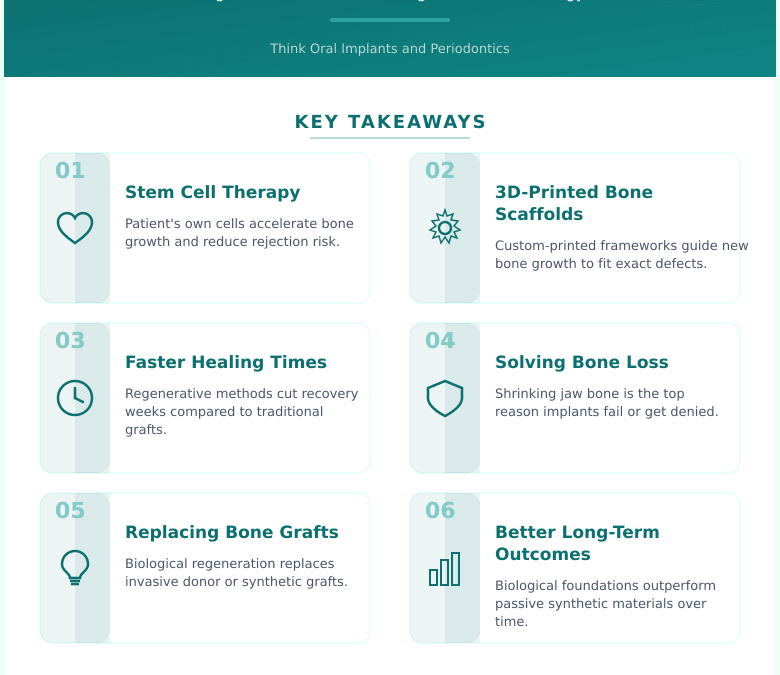
Key Takeaways for Implant Patients in 2026
- Bone loss is not an automatic disqualifier – regenerative protocols are expanding who qualifies for implants.
- Stem cell grafts use your own biology – autologous approaches lower rejection risk and often speed healing.
- 3D-printed scaffolds improve precision – patient-specific geometry means better fit and more predictable bone fill.
- Cost is higher for advanced protocols – but so is the potential for better long-term outcomes in complex cases.
- Specialty credentials matter – verify your provider’s training with the Pennsylvania State Board of Dentistry before committing to treatment.
Frequently Asked Questions
How much does regenerative bone grafting cost without insurance?
The cost of regenerative bone graft procedures varies depending on defect size, materials used, and the practice you choose. Traditional grafts generally run lower than regenerative protocols. Your actual treatment cost depends on your specific anatomy and clinical needs; request a written estimate from your provider before proceeding.
Is stem cell therapy for dental implants FDA-approved?
Several stem cell-based regenerative products used in dental bone grafting carry FDA clearance or approval, though the field continues to evolve. Always ask your provider to confirm that any biological material used in your treatment is FDA-cleared and what clinical data supports its use.
How long does healing take with a 3D-printed bone scaffold?
Early clinical data suggests healing with bioprinted scaffolds may take 2 to 4 months before implant placement, compared to 4 to 6 months with traditional grafts. Individual timelines still vary based on bone defect size, patient health, and material used.
Does dental insurance cover regenerative implant protocols?
Coverage varies widely; traditional bone grafts are sometimes partially covered, while newer regenerative protocols are less consistently included in dental benefit plans. Request a predetermination from your insurer before treatment begins to understand your out-of-pocket exposure.
What credentials should my implant provider have?
Look for a periodontist or oral surgeon holding a DDS or DMD with documented specialty training in implant placement and bone regeneration. Verify active licensure through the Pennsylvania State Board of Dentistry before committing to treatment.
Can I get implants if a previous graft failed?
A prior graft failure does not permanently disqualify you from implant treatment; it does require a thorough evaluation of why the graft failed. Regenerative approaches using autologous stem cells may offer better outcomes for patients with a history of poor graft integration.
Ready to Find Out If You’re a Candidate?
Regenerative implant technology is changing who qualifies for implants and how long the process takes. If you’ve been waiting because of bone loss concerns, 2026 is a good year to revisit that conversation. The options available now are meaningfully different from what existed even two years ago.
Ready to take the next step? Contact us todayfor a straight-talking consultation. We’ll review your imaging, explain which approaches fit your situation, and give you a clear picture of what to expect, including realistic timelines and costs.
About the Author
The Think Oral Implants and Periodontics Team , periodontal and implant care in Paoli, PA. For more information about our approach, visit our homepageor explore our services.