


An implant-supported hybrid prosthesis is a full-arch dental restoration that anchors a fixed, non-removable set of teeth to four or more dental implants placed directly in the jawbone. Unlike traditional dentures, it stays in place permanently and functions much like natural teeth.
This guide focuses specifically on what patients actually experience before, during, and after full-arch implant treatment – from the first consultation through long-term life with a hybrid prosthesis.
Most people considering full-arch replacement have worn uncomfortable dentures for years, or they’re staring down multiple failing teeth and dreading what comes next. The pattern we see most often: patients who waited too long, not because they didn’t want a solution, but because nobody gave them a straight picture of what the process actually involves. That’s what this post is for.
What Is an Implant-Supported Hybrid Prosthesis?
Hybrid prosthesis: A dental appliance that combines a rigid titanium or zirconia framework with prosthetic teeth, secured permanently onto dental implants rather than resting on gum tissue.
Osseointegration: The biological process by which titanium implant posts fuse with the surrounding jawbone over several months, creating a stable anchor for the prosthesis.
The “in a day” part refers to the surgical appointment itself. A skilled team extracts remaining teeth, places the implants, and attaches a temporary fixed arch – all in one visit. You leave with teeth. Permanent, final restorations follow after osseointegration is confirmed, typically a few months later.
Implant-supported restorations are widely regarded as among the most durable tooth replacement options available, and clinical literature consistently reports strong long-term outcomes when implants are placed and maintained correctly.
Implant-Supported Hybrid Prosthesis vs Traditional Dentures: Which Approach Works?
Where implant-supported hybrid prostheses succeed: Fixed stability with no slipping, no adhesive, and no gum irritation. Bone preservation is significant since implants stimulate the jaw the way natural roots do. Patients consistently report eating, speaking, and smiling with far more confidence.
Where implant-supported hybrid prostheses fall short: Higher upfront cost and a multi-stage process requiring surgery and healing time. Not every patient is an immediate candidate – bone density and systemic health are evaluated first.
Where traditional dentures succeed: Lower initial cost, no surgery, and faster delivery. For patients who cannot undergo implant surgery, dentures remain a functional option.
Where traditional dentures fall short: Progressive bone loss continues beneath the gum because there is no root stimulation. Fit changes over time, requiring adjustments. Most patients report reduced chewing efficiency and social anxiety related to stability.
The verdict: For patients who are surgical candidates, an implant-supported hybrid prosthesis outperforms dentures on nearly every functional and quality-of-life measure over the long term. Dentures are a reasonable bridge solution, not an equivalent alternative.
Cost ranges reflect general industry averages (2026) and are not specific to any individual provider’s fees. Actual costs vary based on case complexity, imaging, bone grafting needs, and material selection.
Thinking about this for your situation? Contact usand we’ll walk you through your options – no pressure, just straight answers.
The Full-Arch Treatment Process: Phase by Phase
Phase 1: Evaluation and Planning (2-4 Weeks)
Your care team reviews 3D cone beam CT imaging (CBCT) to assess bone volume, density, and anatomy. This is where implant positions are mapped digitally before any surgery happens.
Key actions during this phase:
- CBCT scan and full oral health evaluation
- Medical history review including medications and systemic conditions
- Treatment plan and cost presentation
- Surgical guide fabrication for precise implant placement
Phase 2: Surgery and Immediate Loading (1 Day)
Under sedation or general anesthesia, implants are placed and the temporary fixed arch is secured the same day. Most patients are able to return home comfortably following the procedure, with postoperative care instructions provided by the surgical team.
Key actions during this phase:
- Extractions of remaining teeth if needed
- Implant placement – typically four to six implants per arch
- Attachment of temporary hybrid prosthesis
Phase 3: Healing and Osseointegration (3-6 Months)
The temporary arch stays in place while implants fuse with bone. Diet is soft during this period – think eggs, fish, cooked vegetables. Swelling and mild soreness are normal for the first two weeks.
Phase 4: Final Prosthesis Delivery (1-2 Appointments)
After osseointegration is confirmed, impressions or digital scans are taken. The final zirconia or acrylic-on-titanium prosthesis is fabricated and secured. This is your permanent restoration.
Your Implant Treatment Preparation Checklist
Before your surgical appointment, gather and complete the following:
- ☐ List of all current medications and supplements
- ☐ Recent bloodwork if requested by your surgical team
- ☐ Arranged transportation home (you cannot drive after sedation)
- ☐ Soft food supply stocked at home for the first two weeks
- ☐ Dental insurance summary of benefits (implants vary widely by plan)
- ☐ Financing approval if applicable
- ☐ Post-op prescription pickup completed before surgery day
What It Actually Feels Like: Honest Patient Experiences
The most common mistake people make is expecting the temporary arch to feel identical to natural teeth immediately. It doesn’t. The first several weeks involve sensitivity, an awareness of the prosthesis, and some speech adjustment. That’s normal and it fades.
By month three, most patients describe the prosthesis as something they forget is there. Eating firm foods, laughing without self-consciousness, not reaching for adhesive in the morning – those are the recurring themes.
Recent data from implant outcome studies shows that patient satisfaction with implant-supported full-arch restorations exceeds 90% at five-year follow-up. That’s not a small number. It reflects a treatment that genuinely changes how people move through daily life.
At Think Oral Implants and Periodontics, we work with patients across the Paoli, PA area who have spent years tolerating removable dentures before exploring fixed options. The conversation is almost always the same: they wish they’d asked the question sooner.
See how our approach compares – visit our services page for a complete overview of full-arch and implant options available to you.
Insurance, Financing, and Pennsylvania Considerations
Most dental insurance plans categorize implants as a major restorative procedure, covering 25-50% of eligible costs up to annual maximums. Full-arch implant treatment often exceeds those limits, meaning out-of-pocket costs are a real planning factor for Pennsylvania patients.
Pennsylvania does not currently offer a state-specific tax credit for dental implant procedures. However, medical expense deductions on federal returns may apply if total qualifying medical costs exceed 7.5% of adjusted gross income (2026 threshold). Consult a tax professional to verify eligibility.
Flexible spending accounts (FSAs) and health savings accounts (HSAs) can be used for implant treatment. Many practices in the Chester County area, including those serving Berwyn, Malvern, Wayne, Devon, and Exton, offer payment plans to manage costs over time.
Frequently Asked Questions
How long does an implant-supported hybrid prosthesis last?
The implant posts themselves are designed to be permanent, while the prosthetic arch typically lasts 10-20 years before needing replacement due to normal wear. Proper home care and regular professional maintenance significantly extend prosthesis lifespan.
Is the full-arch procedure painful?
The surgery itself is performed under sedation, so patients feel little to nothing during the procedure. Post-surgical soreness is manageable with prescribed medications and typically resolves within 10-14 days.
Am I a candidate if I have bone loss?
Moderate bone loss does not automatically disqualify you – bone grafting or angled implant placement can address many deficiencies. Severe bone loss requires a more detailed CBCT evaluation to determine the best path forward.
How much does a hybrid prosthesis cost without insurance?
Full-arch implant treatment generally ranges from $20,000 to $35,000 per arch in the current market (2026). Total cost depends on the number of implants, need for extractions or grafting, and the prosthesis material selected.
Can I eat normally with a hybrid prosthesis?
Yes – after full healing, most patients return to a largely normal diet including most firm and chewy foods. Very hard items like ice or hard candy are generally discouraged to protect the prosthetic material long-term.
What is the difference between a hybrid prosthesis and implant-retained dentures?
A hybrid prosthesis is fixed and non-removable by the patient, while implant-retained dentures snap onto implants but can be removed for cleaning. Hybrids typically feel more natural and offer greater chewing force.
How do I find a qualified provider in Pennsylvania?
Look for a provider with formal implant training, access to in-house CBCT imaging, and a documented process for surgical planning. The Pennsylvania State Board of Dentistry maintains licensee verification at dos.pa.gov.
Your Next Step – Make the Call
Patients in Paoli, Wayne, Berwyn, Malvern, Devon, Exton, and throughout Chester County now have access to full-arch implant options that simply weren’t widely available a decade ago. The technology is reliable, the outcomes are well-documented, and the quality-of-life difference is measurable.
If you’ve been putting this conversation off, 2026 is a reasonable year to stop waiting. Bone loss is progressive, and earlier treatment means more options and simpler planning.
Ready to get real answers about your specific situation? Contact us today and schedule a consultation with our team. We’ll review your imaging, walk through your options honestly, and help you figure out whether full-arch implant treatment makes sense for you – no obligation, no pressure.
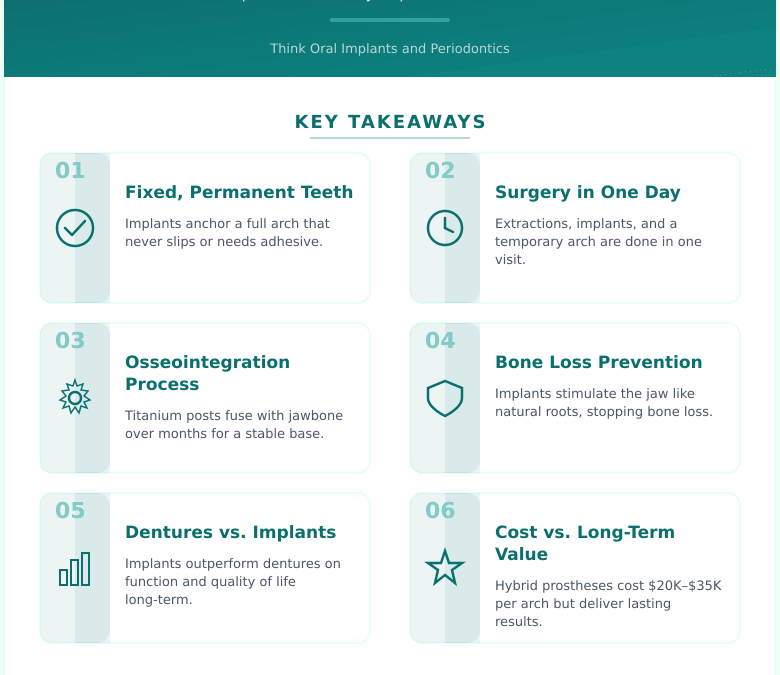
Key Takeaways for Full-Arch Patients in 2026
- Fixed stability is real – an implant-supported hybrid prosthesis does not slip, shift, or require adhesive
- The process is multi-stage – surgery day is just one step in a 4-6 month journey to final restoration
- Bone health matters early – waiting increases the likelihood of needing bone grafting and additional complexity
- Costs vary significantly – get a full treatment plan with itemized costs before comparing providers
- Patient satisfaction is high – long-term outcome data consistently shows this is one of the most life-improving dental procedures available
About the Author
The Think Oral Implants and Periodontics Team , serving patients in Paoli, PA and the surrounding Chester County communities. For more information, visit our homepageor explore our services.